
How a Difficult Puppyhood Affects a Dog

Guardians of dogs — especially adopted ones — often ask where problems like fear or aggression really come from. They wonder how much of a dog’s present behavior is shaped by the past, and whether deeply rooted patterns can truly change. A new study offers an important perspective on exactly these questions.

The First Six Months Matter Most
The study, based on data from more than four thousand dogs, suggests that not all adverse experiences carry the same weight. The researchers looked at a broad range of events, including:
physical punishment, such as leash jerks or being pinned down,
separation from the main caregiver, for example through shelter stays or homelessness,
physical abuse, such as hitting or kicking,
being attacked by another animal,
severe fright caused by a person or in a human-related situation,
serious physical injury or threat of injury, such as a road accident,
and being kept tied up outside for long periods.
What emerged was a clear critical window: the first six months of life.
Negative experiences during this early period — including abandonment, violence, or serious injury — were significantly associated with higher levels of fear and aggression later in life. The effect was stronger than for similar events happening later, during adolescence or adulthood.
That matters, because it suggests that persistent behavior problems are sometimes not just “bad habits” or isolated reactions. They may be deeply rooted responses to stress experienced at a stage when the dog’s nervous system was still being shaped.
This perspective changes the tone of the whole conversation. It invites patience instead of frustration, and understanding instead of blame. Protecting a puppy from overwhelming and negative experiences during this period may be just as important as providing positive ones.
Genes and Environment: Why Breeds Do Not Respond in the Same Way
One of the most interesting findings was that different breeds did not respond to early adversity in the same way. The researchers found evidence of what is known as a gene–environment interaction: a dog’s inherited predispositions influence how strongly negative experiences affect them.
Some breeds appeared more vulnerable to developing fear- or aggression-related problems after trauma, while others seemed more resilient. For example, breeds such as the Airedale Terrier and the Corgi showed a clearer increase in fearfulness following early adversity. In other breeds, such as the Australian Shepherd, the effect was much smaller.
It is also worth remembering that breeds differ substantially in their baseline levels of fearfulness, regardless of trauma history. So early adversity does not act on a blank slate. It interacts with the dog’s biological starting point.
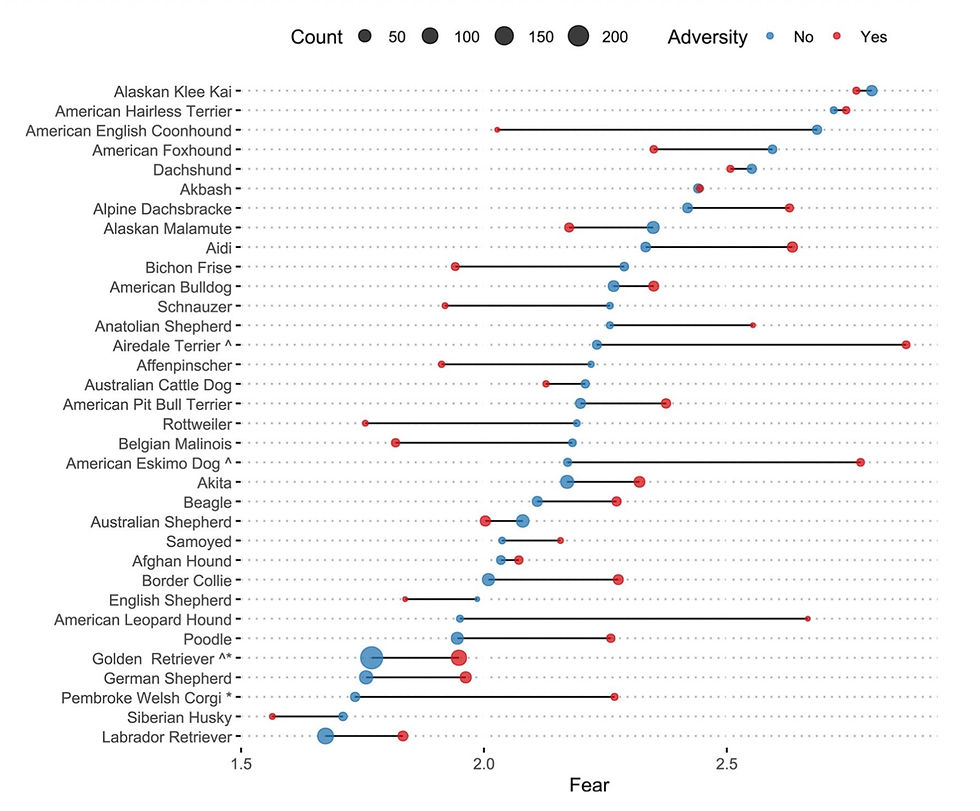
In some breeds, early traumatic experiences are linked much more strongly to aggression, while in others the effect is far smaller — Siberian Huskies and Malamutes are one example of that contrast.

Some breeds also seem more likely to respond to traumatic experiences with fear rather than aggression — retrievers are one example.
This finding is not about labeling breeds as “good” or “bad.” What it does show is that genetic predispositions may shape a dog’s threshold for stress and the way that stress is expressed. For guardians, understanding the breed-related tendencies of their dog can be an important part of understanding the dog’s individual needs. It makes it easier to choose the right kind of support and create living conditions that truly fit the dog.
It also highlights how much responsibility rests with breeders. Selection should not focus on appearance alone, but also on temperament — and on giving puppies the kind of early environment that supports healthy development.
Early experiences, especially those that happen in the first six months of life, can have a profound influence on later behavior. But their final impact is still filtered through the dog’s inborn predispositions. That gives us a more nuanced framework for understanding dogs and supporting them more consciously. Whatever a dog has been through in the past, our role is to create a present that feels safe, stable, and worth living in.
Espinosa, J., Zapata, I., Alvarez, C. E., Serpell, J. A., Kukekova, A. V., & Hecht, E. E. (2025). Influence of early life adversity and breed on aggression and fear in dogs. Scientific Reports, 15(1), 32590. https://doi.org/10.1038/s41598-025-18226-0


Comments