
Inter-species chemistry
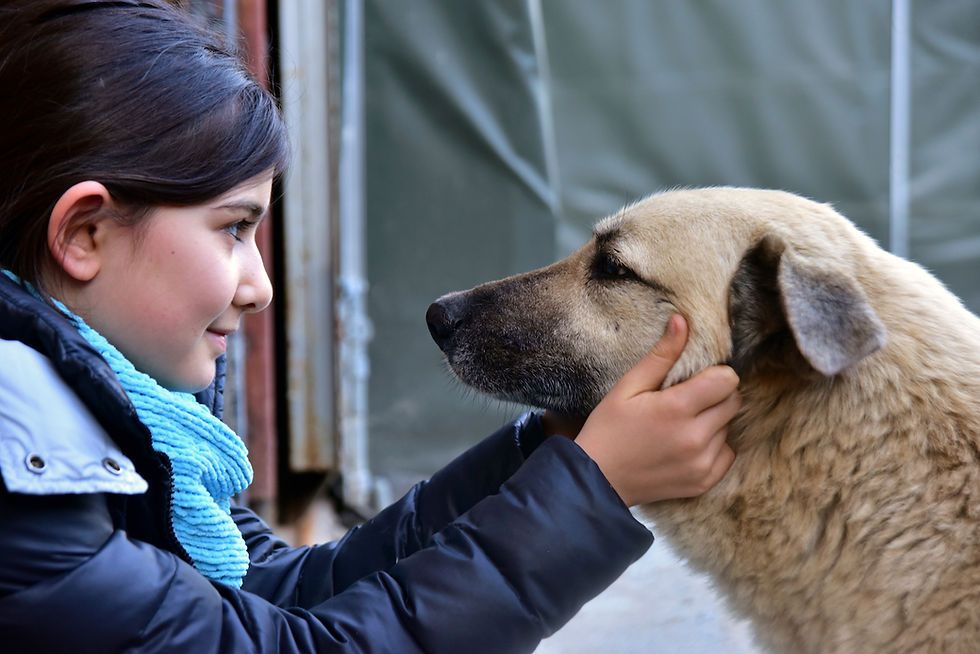
When people call their dogs their children, there’s something to it—at least on a neurochemical level.
Dogs that gaze into their owners’ eyes experience a spike in oxytocin levels, the so-called “love hormone.” Interestingly, their owners’ oxytocin levels rise too. The same surge in oxytocin happens when a mother looks at her baby, especially while breastfeeding. Forming bonds between parent and child is one of oxytocin’s primary roles (also in the animal world).
Since dogs don’t use eye contact to bond with other dogs—dominant dogs stare at subordinates or puppies, and those usually look away—they probably acquired this unique way of bonding with humans early in the domestication process. This may have helped them earn the title of human’s best friend. Humans use eye contact to build relationships and are very sensitive to it, so dogs who made eye contact with people likely gained more benefits from them.
In studies examining this effect, researchers measured oxytocin levels in dogs and their owners before and after spending 30 minutes together. During that time, guardians looked at their dogs, petted them, and spoke to them. Afterward, the dogs’ oxytocin levels (measured via urine) significantly increased. And the same happened with the humans. In similar experiments with wolves—even those raised by humans from puppyhood—scientists did not observe this kind of interspecies feedback loop. (Kikusui, Azabu University, 2015).
In another experiment, researchers administered oxytocin via nasal spray to dogs. Afterward, female dogs gazed longer at their owners, which in turn led to increased oxytocin levels in both dogs and people.
Scientists also found that human contact with dogs doesn’t just raise oxytocin—it lowers blood pressure and boosts a whole range of hormones, including beta-endorphins (linked to euphoria and pain relief), prolactin (linked to parenting behaviors), phenylethylamine (which rises when we fall in love), and dopamine (associated with pleasure). (Odendaal, University of Pretoria; Nagasawa, Azabu University, 2013).
Dogs manage to draw us into emotional bonds similar to those we form with the people closest to us!
Miho Nagasawa, Shouhei Mitsui, Shiori En, Nobuyo Ohtani, Mitsuaki Ohta, Yasuo Sakuma, Tatsushi
Onaka, Kazutaka Mogi, Takefumi Kikusui, Oxytocin-gaze positive loop and the coevolution of human-dog bonds, Science 2015, Vol. 348 (6232), 333-336


Comments